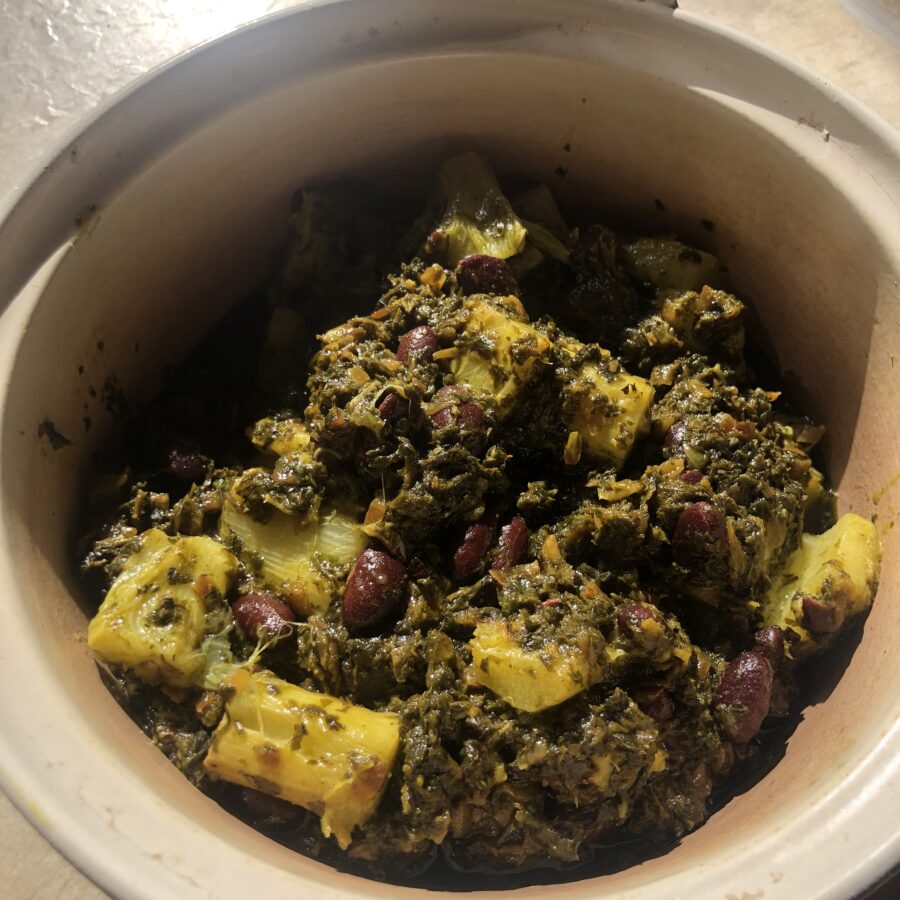
Khoresht e Rivas is the perfect way to use homegrown rhubarb. This Iranian rhubarb stew is savoury and sour, full of vegan protein and super healthy!
Khoresht e Rivas is similar to Ghormeh Sabzi – قورمه سبزی, but not as well known. I have cooked this dish for a dozen Iranian friends so far, and none of them had heard of the dish. This is the perfect way to try a new, savoury way to cook a glut of rhubarb. You can adjust the amount you put in according to your taste: more for tartness, less for earthiness.
History of Rhubarb in Iran
Thought to have originated in China, rhubarb is now eaten around the world. It is valued for various medicinal properties and for being easy to grow. The Farsi word for rhubarb, ‘ریواس’ or ‘rivas’, is similar to the translations in Arabic, Turkish, Kurdish, and even Russian because they are all influenced by the Ancient Farsi word [1]. This suggests that rhubarb was introduced to Iran and then spread to nearby countries through trading, taking the Persian name with it.
Now, in Iran and surrounding countries, a wild species (Rheum Ribes) grows on rocky hillsides and is incorporated into the local cuisine to aid digestion as well as for taste [2]. A friend shared a memory from Iran with me of feeling refreshed from eating raw rhubarb. Iranian rhubarb is sweeter and has a more delicate flavour than the acidic UK rhubarb. However, both are delicious in this khoresht, giving the classic sour element to this Iranian dish.
Of course, rhubarb is well known for its strong sour flavour and this matches Iranian cuisine perfectly. Iranian stews (Khoresht) usually use a souring agent such as verjuice, pomegranate juice, or dried lime (which create a balanced flavour when served with rice and tahdig). However, with rhubarb as the main ingredient in Khoresht Rivas, nothing else is needed to give the dish that classic sharp taste.
Rheum Ribes is a little sweeter than UK rhubarb and is often eaten raw as well as cooked in jams.
When do you pick rhubarb?
In the UK, early varieties of rhubarb are available from April and some go through to July. However, I have managed to pick rhubarb as early as March – perfect for Nowruz celebrations. The flowering stem of the rhubarb on the mountains of Iran can also be harvested April-June [3]. The trip to the hills is not wasted as many other herbs are also usually collected and used for stews and breads.
Rhubarb is such an easy plant to grow in the garden. To pick, snap off the poisonous leaves and take home the crunchy red/green stalks.
In the UK, Spring is also the perfect time to forage for garlic leaves. (Please only do so if you are confident of plant identification.) You can use garlic leaves as part of the herb mixture.
Cooking tips for Khoresht e Rivas
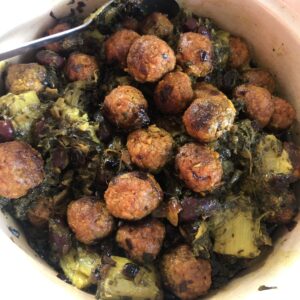
Rhubarb Stew can be made with a variety of protein options instead of meat. If you prefer to cook with whole foods, use kidney or black beans. If you prefer to cook with a meat substitute, you can use any brand of no-meat chunks, tempeh, seitan for ease, or make no-meatballs out of mince…. For meatballs use the pliable mince found in the fridge section of supermarkets, rather than the firmer version in the freezers. Common brands in the UK include Meatless Farm soya-protein, Beyond Meat (pea-protein), THIS (soya-protein). I wouldn’t suggest tofu because ingredients with firm texture and extra flavour work better to balance the rhubarb and herbs.
- Take your time frying onions (check the oil is hot, add onions, then turn to a low heat) – you can prepare other ingredients while you wait.
- If you can prepare the dish early, the taste will become more complex as the flavours marry.
- Don’t stir the pot once the rhubarb is in – it will break up easily.
- Serve with rice (preferably Iranian style).
If you like this recipe, try Khoresht e Karafs | Persian Celery Stew | خورش کرفس for a similar herby flavour with less sourness.
Is Rhubarb Stew Healthy?
Globally, rhubarb has been applied medicinally for many centuries. From improving digestion, to treating a range of physical and psychological disorders. However, the strength of rhubarb can also be seen in its toxicity. As well as the leaves, the stalks also contain oxalic acid which can cause kidney stones if eaten in abundance. In this recipe I advise removing the thin outer red layer, which contains a higher concentration of oxalates. However, if you are keen to keep the pretty colour, it is still edible.
This recipe includes the traditional method of frying onions and herbs in quite a lot of oil. Although I prefer to cut back on oil in my daily cooking, I do use plenty of oil for celebrations with friends. This helps to achieve flavour designed to balance well the sourness of Iranian cuisine, with rice, with pickles… I think it also helps to give friends a full taste experience when trying vegan alternatives of dishes they might already be familiar with.
If you prefer to make this recipe healthier, simply cut back on oil, and opt for one of the whole food protein options suggested above instead of meat-alternative products.
References:
- Foust, C. M. (2014). Rhubarb: The wondrous drug. Princeton University Press.
- Rheum Ribes (Wikipedia) https://en.wikipedia.org/wiki/Rheum_ribes (Accessed 20/3/26.)
- https://pfaf.org/User/Plant.aspx?LatinName=Rheum+ribes
Ingredients
Instructions
- Start with the vegetables prepared. Discard the thick stalks of the herbs and wash the remaining leaves. While drying, peel and finely dice the onions. Separately, chop the herbs very finely - like a pesto. Prepare the rhubarb by remove the thin red outer layer, washing, and cutting into inch long pieces. Prepare the liquid saffron by adding 100ml boiling water to the ground saffron. Leave to release the flavour.
- Fry the chopped onion in hot oil on low heat until beginning to brown. If using mince, mix in the tomato paste and a little of the spices, then roll into small balls (2cm diameter). Add the remaining spices to the onions along with the meatballs. Keep moving the meatballs gently around to fry on oil sides. You might need more oil.
- In a separate pan, fry the mint, parsley, and green onion leaves with a pinch of salt. Mix and fry until the colour darkens and the texture becomes almost crispy.
- Once the meatballs are brown and crispy all around, add half of the liquid saffron and cook until mostly evaporated. Remove the meatballs and 2 tbsp of the onion, setting aside for later. Add the herbs to the onions and add the beans (if using). Continue to fry, stirring occasionally.
- Fry the rhubarb in the pan used for the herbs. Turn over once the outer side is cooked. Let the middle remain a little hard, as it will get cooked later.
- Pour the vegetable stock and remaining liquid saffron into the main pot, stir, and leave to cook until the liquid has reduced a little. Add more liquid if needed (it shouldn't be watery nor dry). If you like, add more salt and pepper. Some stock may be salty enough already. If you have plenty of time, you can slow cook for longer at this stage to help the flavours infuse.
- A few minutes before serving, add the rhubarb carefully to the pot. Turn over gently to mix them in. If you are serving straight from the pan, add the meatballs on top to reheat, you can mix them in a little too but it is nice to see some on top. If you are transferring to a serving bowl, use the other pan to reheat the meatballs. Decorate the khoresht with the meat balls once in the bowl. Serve with rice (preferably prepared Iranian-style - see above for recipe link).
Notes
Serve this Rhubarb Stew on traditional Tahdig: soft rice with crispy potatoes.
Did you make this recipe? Tag @vegan_middle_east on Instagram or comment below.
[…] knew you could use rhubarb in a savory dish!? Not us, so when Tim found this recipe, we eagerly added it to our menu. Though it’s traditionally made with red meat (either beef or […]